


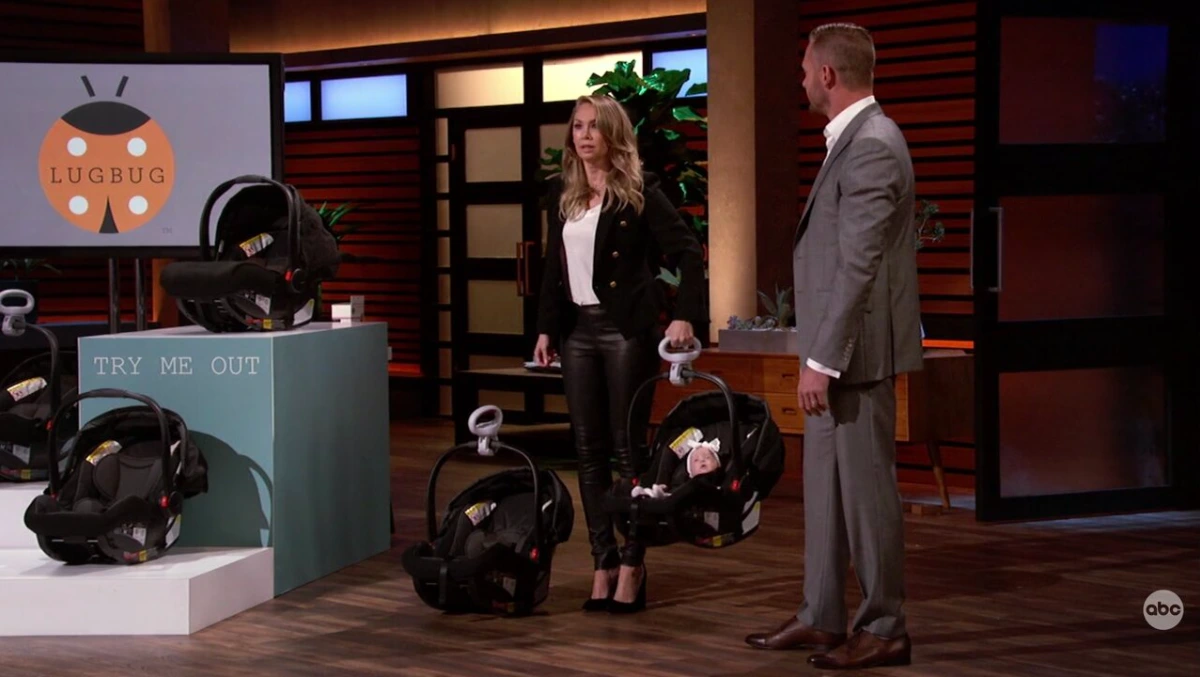
Founder Nathan Day appeared on Shark Tank Season 10 Episode 4 to pitch LugBug. His product was essentially a baby car seat handle that makes carrying and lifting safe and easy. This uncanny invention came from a painful moment in his own life.
Inspiration Behind LugBug
While carrying his baby daughter, the father of three bumped the car seat against his leg and twisted his arm. The awkward angle dislocated his shoulder. That injury led him to design a safer, easier way to carry a car seat.
Many car seats are designed in a way that forces parents to hold them at an awkward angle, putting extra pressure on the wrists. It’s actually more natural to carry weight with your hand turned to the side. Basically, the way you’d hold a briefcase.
Research shows that this hand position makes lifting easier and steadier. Since most car seats don’t follow that design, Nathan came up with LugBug to make carrying simpler and more comfortable.
What is LugBug?
LugBug is an attachable handle that clips onto a baby car seat and swivels so you can carry it in a more natural hand position. It’s made to fit nearly all car seat models. If it doesn’t fit yours, there’s a full money-back guarantee. The handle can hold up to 100 pounds, so it’s strong enough for any baby seat.
LugBug Shark Tank Pitch
Nathan came into the Tank asking for $300,000 in exchange for 10% equity in his company. To make an impression, he brought along Robert’s wife, who walked in carrying their twins in car seats fitted with LugBug handles. She said they made the seats easier and more comfortable to carry.
If that was an attempt to lure in Robert, it ended up falling face-first miserably (keep reading).
Nathan shared his pitch and passed around samples. The business had earned $238,000 in total sales. Around $198,000 of that came in 2017.
Each unit cost him about $6 to make and sold for $39.99, giving lucrative profit margins. It all sounded too good to be true, and that’s when he revealed that he had poured $750,000 of his own money into patents and manufacturing.
Kevin O’Leary, as usual, began his grilling questions after hearing the numbers. He asked if major retailers like Target or Walmart had shown interest in carrying the product. Nathan said that they preferred to test it online before putting it on store shelves.
No one expected Robert’s demonstration to spell trouble for the business, but that’s exactly what happened.
Robert showed Nathan and the Sharks how he carried a baby carrier, following his pediatrician’s advice. He said he wouldn’t back a product he wouldn’t use himself and chose to leave the deal.
Mark Cuban and Kevin O’Leary liked the idea but worried there wasn’t enough demand to support future growth. Barbara Corcoran praised Nathan’s presentation but questioned why he had spent so much on patents before proving the product could sell.
As someone who has a niche in everyday products that help people, Lori Greiner saw potential in the concept. She advised Nathan to consider licensing it to an established car seat company.
In the end, none of the Sharks made an offer, and Nathan left the Tank without a deal. Robert’s casual demonstration of an alternate way to carry ended up being the final nail in LugBug’s coffin.
Why LugBug Struggled to Gain Traction
Apart from the fact that LugBug was essentially a handle for a handle (making it counter-productive and oxymoronic in nature), here are some technical criteria the product failed to qualify for as well:
- Market Fit Concerns: Robert Herjavec demonstrated an alternative method for carrying car seats that didn’t require additional tools, questioning the necessity of the LugBug handle. This raised doubts among the Sharks about the product’s market demand.
- Financial and Sales Challenges: Nathan reported nearly $200,000 in sales in the past year (2017). Total sales over the previous three years were $283,000. He had also invested $750,000 in patents and manufacturing, raising concerns about the company’s long-term viability.
- Retail Challenges: Nathan mentioned that major retailers like Target and Walmart were hesitant to stock the product in stores, preferring to test it online first. This suggested potential challenges in scaling the product through traditional retail channels.
Could Investment Have Made a Difference?
The company seems to have ceased operations. Its Facebook page hasn’t seen any activity since June 2017, and the website shows all handles as sold out. Last update on Nathan’s LinkedIn profile showed him as the CEO of a luxury residential development firm called Cypress Development Group.
The LugBug business appeared to be inactive in June 2021, and that status has remained the same ever since. The website is also no longer functional. It’s fairly reasonable to conclude the company has effectively shut down.
Was this bound to happen, or could this outcome have been avoided if the Sharks were not so reluctant to give a helping hand? Guess we will never know.
LugBug had a clever idea and a real story behind it, but even good intentions can’t always guarantee success. The journey was full of lessons about timing, market demand, and how much risk entrepreneurship carries.